
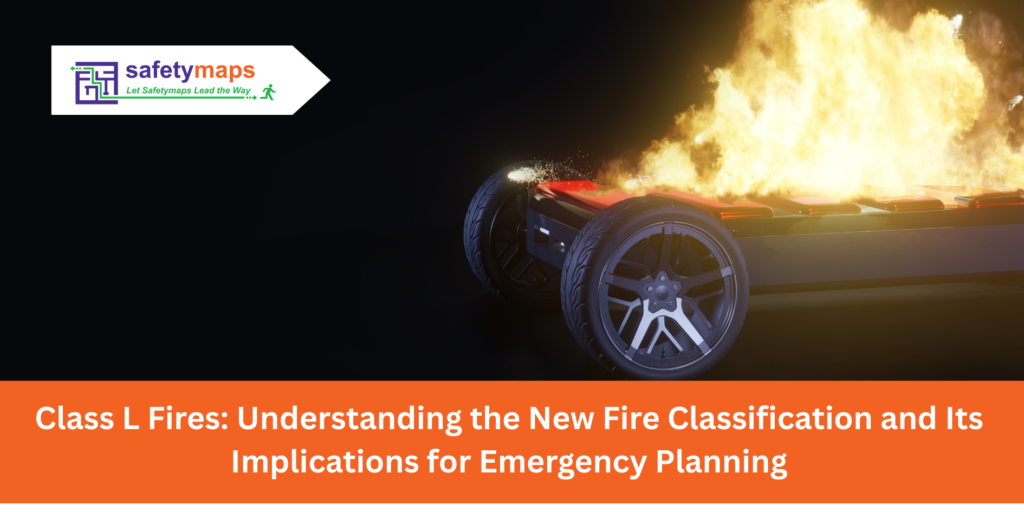
In recent years, the fire protection industry has had to rapidly adapt to an emerging hazard that does not behave like the fuels we have managed for decades. As lithium-ion batteries become ubiquitous—powering everything from handheld tools and medical devices to electric vehicles and large-scale energy storage—the risk profile of the modern facility has fundamentally shifted. This shift has led to the informal but increasingly common establishment of a new fire classification: Class L fires.
At Safetymaps.com.au, we believe that effective emergency planning is built on technical understanding, not just equipment procurement. To manage the risk of lithium battery fires, facility managers and Emergency Planning Committees (EPC) must look beyond the “shiny new kit” and understand the unique chemical and physical challenges these incidents present.
The Mechanics of a Class L Incident
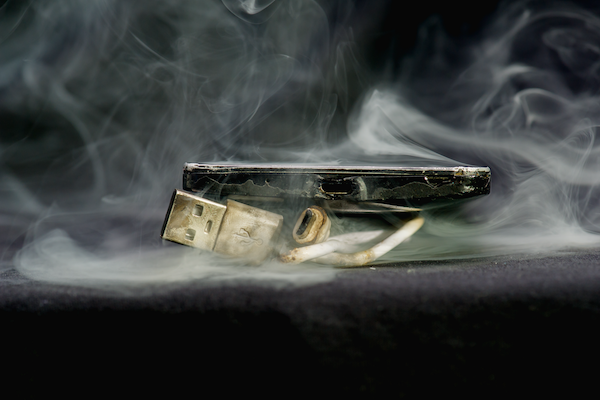
A Class L fire involves lithium-ion or lithium-metal batteries. What distinguishes these from traditional fire classes—such as Class A (solids) or Class B (liquids)—is the phenomenon of thermal runaway. This is a chemical chain reaction where an internal failure, physical damage, or overheating causes a cell to release its stored energy as heat. This heat then triggers adjacent cells, leading to a self-sustaining and rapidly escalating fire.
Unlike a standard electrical fire (Class E), a lithium battery fire provides its own fuel and, in many cases, its own oxygen source through chemical decomposition. This means that traditional suppression methods, which rely on excluding oxygen or removing heat, often struggle to reach the core of the battery pack where the reaction is occurring. Furthermore, these incidents are notorious for their “re-ignition” potential; a battery may appear extinguished, only to enter thermal runaway again hours or even days later.
The Operational Challenge: Why Traditional Methods Fall Short
The hazards of a Class L event extend far beyond visible flames. When a battery enters thermal runaway, it vents a complex cocktail of toxic and flammable gases, including hydrogen fluoride and carbon monoxide. In a confined space, such as a charging room or a basement car park, this creates an immediate inhalation hazard and a risk of secondary explosions.
From an emergency planning perspective, this changes the “first-aid firefighting” logic. In a standard Class A fire, a trained staff member might successfully use a water or foam extinguisher to douse the flames. In a Class L scenario, the priority often shifts from “extinguishment” to “containment and isolation.” The goal is to prevent the fire from spreading to surrounding structures while managing the toxic smoke plume and preparing for a long-duration event that will likely require specialized intervention from Fire & Rescue services.
Evaluating New Technology: Fire Blankets and Type L Extinguishers
To meet this challenge, the market has introduced specialised equipment, most notably lithium fire blankets and Type L extinguishers.
Lithium fire blankets are engineered to withstand the extreme temperatures of a battery fire (which can exceed 1,000°C). Their primary function is to “smother” the incident—not necessarily by cutting off all oxygen to the chemical reaction, but by containing the flames, preventing radiant heat from igniting nearby objects, and filtering some of the toxic particulates.
Type L fire extinguishers often utilize specialized agents designed to cool the battery and interrupt the thermal runaway process. However, it is a technical mistake to assume that installing these units is a “set and forget” solution. The effectiveness of any extinguisher is limited by the size of the battery; what works for a mobile phone may be entirely insufficient for an e-bike or a pallet of stored cells.
Beyond the “Shiny New Kit”: The Role of Risk Assessment
At Safetymaps.com.au, we often see “Shiny New Kit Syndrome,” where facilities purchase expensive equipment without updating their underlying procedures. True compliance with AS 3745-2010 (Planning for emergencies in facilities) requires a multidisciplinary risk assessment.
You must ask: Where are these batteries being charged? Is the area ventilated? Is there a clear evacuation path that doesn’t lead past the highest-risk charging station? If a fire blanket is used, who is trained to deploy it safely without being overcome by toxic fumes?
An emergency plan is only as good as the technical logic behind it. This means your evacuation diagrams must reflect current hazards, and your Emergency Control Organisation (ECO) must be briefed on the specific “trigger points” for a Class L event—knowing exactly when to stop fighting and start evacuating.
Integrating Standards: AS 3745 and AS 4083
For those managing commercial or healthcare facilities, the integration of Class L risks into your AS 3745 or AS 4083 framework is now essential. This involves updating your Emergency Management Manual to include specific sub-procedures for battery incidents, ensuring your fire wardens understand the re-ignition risk, and aligning your equipment maintenance schedules with the manufacturer’s technical requirements.
Safety is a technical discipline. By moving away from gimmicks and focusing on the technical reality of Class L fires, we can create safer environments that are prepared for the challenges of modern technology.